Wednesday, October 24, 2012

Golden Cave Temples, Dambulla

I have a previous post about these awesome, ancient temples so I will try not to repeat photos or information. Post January 2011.

The five cave temples at Dambulla are on many overseas visitors "must see" list because of the extensive art which covers almost every bit of the walls and ceilings. This was the main reason for our visit this time. No matter what direction you come from, it would be difficult to miss this significant site!
Golden Temples, Dambulla, from the road.
If you look to the centre right of the above photo you will see the dwarfed figures of the first monks in the line with more shown in the photo below. It's an inviting sight from the road! This complex is very new, compared with the ancient Cave Temples on the mountain behind it, having been completed in 2001. It was built to commemorate the 30th anniversary of the Chief Monk of the Temple's life as a monk. The Buddha is seated on top of a museum which we missed seeing as we were too early.
Statues of monks, Golden Temple, Dambulla
It has been said that the Chief monk wanted to have the biggest Buddha statue in the world but apparently it is not. At 100 feet or 30 metres high it is, however, the biggest one in Dhamma Chakka posture.
Dhamma Chakka Posture
Dhamma, meaning Buddha's teachings and Chakka, meaning wheel can be translated to mean following the teachings of the Buddha's first sermon to enlightenment. If you study the photo you will see that the Buddha's right forefinger and thumb form a circle - wheel, while the fingers are fanned to represent his first teachings.

After a look around this new statue we began our climb up the steps to the ancient Cave Temples. We had made an early start because we were visiting the area at the hottest, driest and dustiest time of the year - rain was due with the imminent monsoon winds. The heat from the rock can be searing during the middle part of the day and I would not like to climb all the way up minus shoes which is what I saw some overseas visitors doing! There is no need to remove your shoes until you get to the Cave's entrance where you can leave them to be minded while you go inside.

We took the climb slowly enjoying seeing female brown monkeys running about, babies hanging under their bellies, as they scanned for food possibilities. Not so enjoyable was the sight of a troupe of them mauling a small, shrieking puppy, its mother having to leave it to its fate as she carried her three other babies to safety, one by one. I couldn't make myself stay see the outcome of this attack.

At the top we had our tickets checked and I engaged a guide with the idea that he would be able to give us the historical and religious context of the paintings and statues we were to see. Although I had been to these temples before and have read quite a lot about them, I didn't feel confident enough to talk to my companions, who were on their first visit, about them. It turned out that he seemed to have his set speech telling the number of statues in each cave, areas covered by paintings and other basic information. When I tried to engage him further by asking about the kings who were involved during the centuries, I was taken outside, given the briefest answer and told he had finished his tour. Once paid, he ran off, no doubt to find another party for the same speech.

One of the kings was King Valagamabahu of Anuradhapura, 1st century BC, who  lived there for some time while he gathered an army to challenge his South Indian usurper.  As a token of his thanks, he built one of the temples.  In the temple that was closed, there is a huge mural with the king and his warriors. There are photos of it in my previous post about another visit here.
Cave Three - Maha Aluth Viharaya 
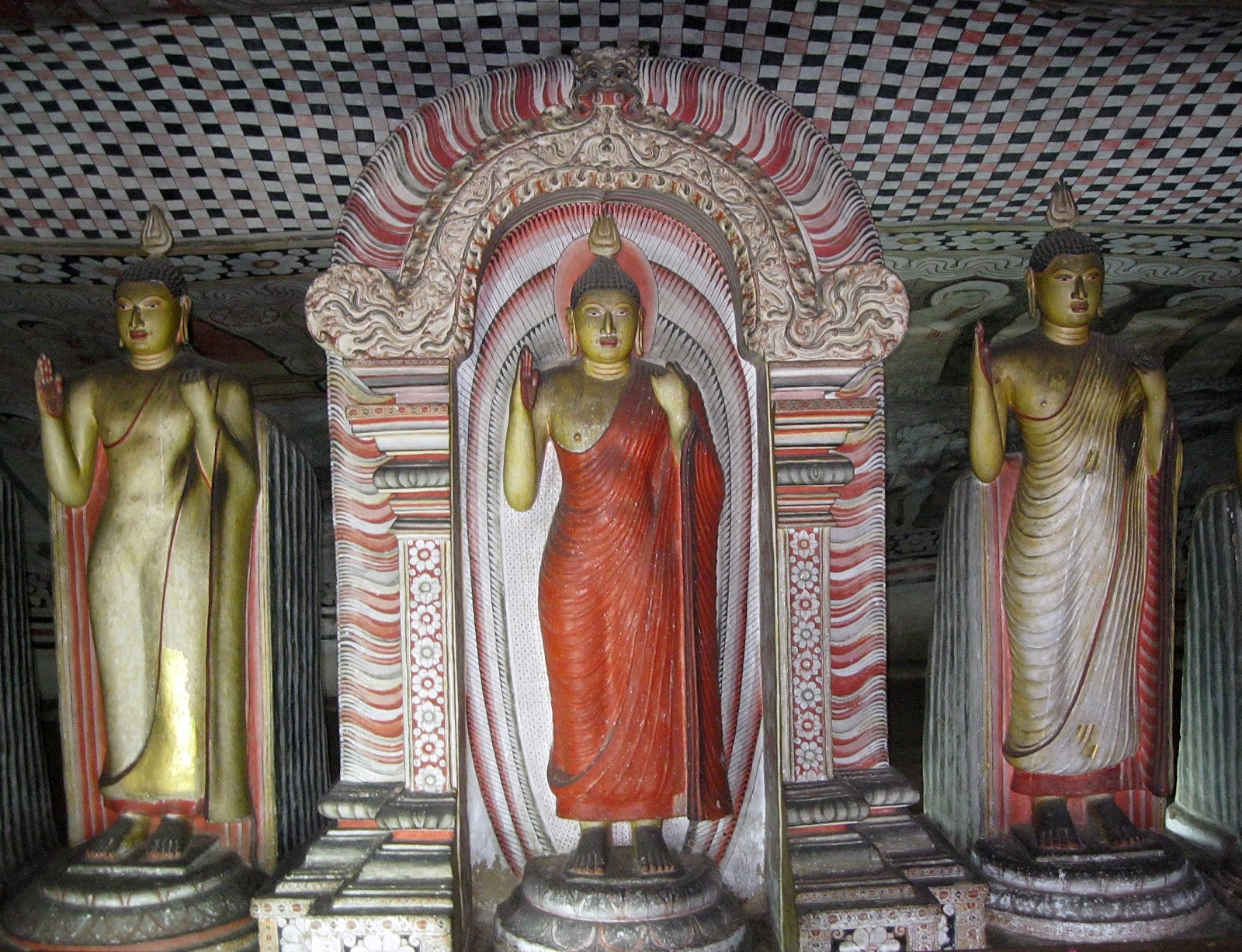
The Third Cave, Maha Aluth Viharaya, is the second largest cave at about 90 feet long, 81 feet wide and 30 feet high with a sloping rock ceiling. It  has become a temple relatively recently as it was used as a store room until the 18th century. The ceiling is covered with frescoes depicting the Buddha's life and Buddhist events. There are 50 images of Buddha, including the reclining Buddha looking quite peaceful.
King Keethi Sri Rajasinghe
King Kirthi Sri Rajasinghe's claim to fame here is that he had this cave, the third one, converted to a shrine. 
Dambulla Cave Temple
Our guide moved us around quite quickly and I became confused as to which cave we were actually viewing - we seemed to have missed one. When I asked about this, I was told that one cave was closed. Why? Due to bad things, was the answer. Even more confusing. After this answer he went off, out to another cave. Lesson learned here. I won't get a guide should I visit again!

Dambulla Cave Temple


Dambulla Cave Temple
The pillow looked so soft but in reality it is made of bricks and mortar.


Dambulla Cave Temple

There were only a few people in the caves. Those who came to worship quietly moved from one significant Buddha to another, some leaving a few flowers as an offering.


Worshiping at the Cave Temples


Women worshiping at the Cave temples
It was peaceful, quiet and cool - the place for quiet contemplation.
Cave Temples
Dambulla Cave Temple
The rock ceiling is, of course, uneven with ridges, dips and curves and this makes the paintings on them all the more remarkable. These murals illustrate the life of Buddha, his sermons and some aspects of the history of the country. Overall, they cover 2,100 square metres.
Ceiling Mural, Dambulla Cave Temple
Mural, Dambulla Cave Temple
Mural, Cave Temple, Dambulla
On this, my second visit, I noticed things not seen previously and had the added pleasure of revisiting statues that had stayed with me since my last visit. For me, it's the kind of place that I could return to several times. When I could finally pull myself away, I found my friends sitting outside watching a large group of pilgrims make their offerings to a shrine under the Bo tree and enjoying the view.
View from the Temple grounds at Dambulla

Dambulla
As we left, the Buddha sat, high on the rock, watching the world below.

If you look closely you can see Sigiriya Rock just left of centre.

Saturday, October 20, 2012

Sigiriya Rock Fortress

Our whirlwind Glimpse of Sri Lanka Tour with Olivia and Leona continued towards Sigiriya today with a break at Matale for lunch and also at the Noritake factory and showroom where I bought some small teacups as a memento of this trip. In Kandy we had stayed again at Nature Walk guesthouse where we were as comfortable as usual. Sarath, the owner had arranged our Sigiriya accommodation for us at a new place called "Nice Place" and although it was a little difficult to find, down a dusty side road, it was indeed  nice place, set in the bush. As this time at the end of the rainy season, it is very dusty and dry. Birds and animals are coming out of the secluded bush in search of water so we had the benefit of birdsong, the trumpeting of an elephant and screeching of monkeys to emphasise the off the beaten track nature of the guesthouse.

After afternoon tea on our veranda and a short rest, Olivia and I were off to climb Sigiriya. I have a previous post about our last visit there - January 23 2011. Conditions then were the opposite of today's - then very wet, low visibility and an early morning climb. On arrival we found the ticket office and paid our RS3,900 - the admission price fluctuates according to the value of the rupee, I was told, as the owners and government have a declared practice of getting as much as they can from the tourist.  We then began out walk through what, in King Kassapas time, were the water gardens. First we had to cross over the moat.
Moat, Sigiriya
The gardens were designed symmetrically and we walked down the straight path through the middle towards the towering rock, boldly standing in the harsh, late afternoon sun.
Sigiriya Rock, Sri Lanka
As we reached the trees at the foot of the rock our climb began. Steadily we went higher, pausing to take in our surroundings and appreciate the low sun creating vivid colours of the green vegetation against the starkness of the rock rising some 370 metres [ 1,214 feet] above sea level.


Olivia pauses on the first steps
The late afternoon sun casts a surreal glow behind the trees
Before long the flights of steps became steeper until we were at the Ancient Art Gallery where our tickets were checked before we went up the narrow spiral staircase to the cave housing the frescos. Here's one - there are more in my previous Sigiriya post.
Sigiriya ladies
There are two spiral staircases, one going up and the other for coming down. The down one is where I caught my arm and gashed it previously so I was very careful this time. Lucky I was, as it looked as though not a thing had been done to repair the rails since my last visit.
The side of Sigiriya
After the Art Gallery, there is a narrow walk way on the side of the rock. Looks shaky and scary but it's well anchored and sturdy. On my last visit I paused here and waited for the rain to stop before taking a photo. This time visibility was clear and the air below dusty.
Lion's Paw entrance
At the Lion's Paws we sat down for quite some time to enjoy the view below and to watch people on the stairs attached to the side of the rock. Then, as the sun was rapidly setting, we entered through the Lion's Mouth and climbed, section by section until we were at the top. I must admit that I took the last few sections quicker than I planned because I saw some hornets flying into a crevice in the rock. These hornets are present on the rock only during the dry season and they have caused problems for climbers with some reported as dying from their stings. Suits are provided for people to wear when they are very active but I'd give the climb a miss myself in that case! However . . .
Hornets
. . . we clambered up the last few steps and there they were! Very quietly I clicked my camera, backed off and left them to get cosy for the night. I made a mental note not to go back down this way!
Ruins of King Kassappa's Palace
The Sigiriya Rock Fortress is now a UNESCO historical site with evidence of habitation found dating back to the Mesolithic Period. As we walked through the park like area and began the climb after the Lion's Mouth, I saw that there had been quite a lot of excavation done since my last visit, with more ruins now showing, but still fenced off.

The lower part of the rock was used as a cave monastery in the 5th Century BC. King Kassappa's time there was around 477 - 495. After his death it was used as a monastery again until the 14th century after which it seems to have been abandoned until the 16th - 17th Century when it was used as an outpost by the Kandyan kings.
Palace ruins on Sigiriya
The top of the rock is flat, giving 360 degree views.
Gardens below

It was very pleasant and surprisingly still on top as we walked the perimeter taking in the views from all around. The sun was setting alarmingly fast and, as we didn't  relish the idea of descending torch-less in the dark, we reluctantly headed down the staircase. There are a few alternative paths down after the Lion's Paws and we took one past the new excavation area and through the quiet park.  There was one couple ahead of us but they soon disappeared from view leaving us alone in the peace of the end of the day.
Last sight of the Rock from the alternative path
As the dark finally enveloped us, we arrived at the gate to be met by our very worried driver. It was the end of a memorable day!


Friday, October 19, 2012

Temple of the Tooth, Sri Dalada Maligawa, Kandy

While travelling I often get into conversations with people waiting to board planes, during flights, in restaurants, on buses . . .  everywhere, my nearest  and dearest would say. It seems that in these circumstances the likelihood of meeting people with similar experiences and interests, outlook on life and so is greatly increased and a good number of these conversations have led to continued contact and subsequent meetings. 
Olivia at Olu Ella Inn
It was one such conversation four years ago that led to Olivia and her mother, Leona, making a quick visit to us at Olu Ella Inn. Our meeting with Olivia and Andrew in an airline check in queue at Kuala Lumpur led to, among other things, their generous assistance in getting a new website for our guesthouse and also to rapid up skilling of my knowledge of the world wide web, website production and blogging.
Leona
Olivia and Andrew have recently expanded their business in Software Development and Management, based in Sydney to Kuala Lumpur. What they do seems very complex to me so here's their website.

http://sakurasky.com/

Olivia is a gifted painter, among other things, so I wanted to arrange a mini tour for the remaining two nights of their visit with this in mind. First up was a visit to the Temple of the Tooth, Kandy and our timing for our interests was perfect with few people around, amazing late afternoon light and tranquil atmosphere.


We entered by the back gate next to the Royal Baths on Kandy Lake. From here, in the late afternoon sun the gold coloured roof of the Library building stood out against the white of the buildings and parapets. 
Temple of the Tooth Library building
For Olivia and Leona's benefit I was thinking of engaging a guide so when we were approached at the ticket office by a energetic man who responded cheerfully and helpfully to my questions regarding his authentication and certification, the decision was made. What a good one it was! Ajith gave us the perfect tour for us with his enthusiasm, knowledge and preparedness to do that extra bit that makes a good tour a great one.

Ceiling at the Entrance
The last time I visited the temple [ posted in February 2011] it was a Poya day and the place was packed with devotees making offerings, listening to sermons, meditating in corners everywhere. It was one huge crush of bodies all trying to get to see the Tooth casket which, accompanied by drummers and horns, had been brought out for a few minutes. We were squeezed and jostled so much that we made a hasty exit. This time we were able to take our time, could pause to enjoy and admire the architecture, murals, statues and carvings that were invisible to me earlier.
Decorated Tunnel Entrance leads into Drummers' Hall and the Shrine Room 


Tooth casket is kept securely behind this beautiful curtain
To give some context to this account : The Sacred Tooth is believed by Buddhist devotees to have been retrieved from the ashes of Buddha's funeral pyre in India by Arahat Khema who gave it to King Bramadatte who was a Buddhist. The King venerated the Tooth and it became an important Royal possession. As time passed, the belief arose that whoever held the tooth had the divine right to be King. Buddhism was a new religion and so had many enemies and of course wars were fought to gain possession of the Tooth and to destroy it. Its time in India came to an end when King Guhaseeva held it. He had become Buddhist and worshipped the Tooth so when he heard that a large army was being organised to attack him with the aim to destroy it, he sent it to Sri Lanka with his daughter Hemanmala and her husband. The story goes that she hid it in her hair. 

Once in Sri Lanka, the belief that whoever held the Tooth was the divine ruler of the island so the Tooth was held by different Kings until lastly, it was held by the Kandyan King. It is brought out briefly three times daily - dawn, noon and in the evening during which times many people come to worship and make offerings. It is kept here in seven gold caskets, engraved with jewels and shaped like a stupa.
Beautiful motifs, murals and art decorating the eaves and pillars                   of the Shrine Room


 Ajith was fascinated with the ipad and keen to take photos with it!
Moonstone
 This moonstone at the foot of the stairs that lead to the Library where manuscripts etched on papyrus are kept. This room is open only at certain times so we were unable to see it this time. Unlike the Moonstones of Anuradhapura, Polonnaruwa and Mihintale, those in this Temple do not have rings of animals.


Hindu aspect
Devotions

Bronze Standards
 After a leisurely look around the Drummers' Hall and Casket Shrine area we went up to the upper level - I believe this is the place where the Tooth is shown. Alongside this is the Chanting Place which I have seen so very packed and heavy with an electric atmosphere. Today, however, only a few people came quietly to offer flowers so it was a calm, peaceful place.
Upper Level, above Casket Shrine

For once, there was no Buddhist Statue. The devotees come here to worship the enshrined Tooth.

Flower Offerings
Slowly, guided by Ajith, we made our way outside into the courtyard . . .
Eaves intricately decorated

. . .past the two guardstones
. . .on the left, and . . .
. . .on the right

. . . up the steps . . .
Holding up the steps

to my favourite part of the Temple complex which is sometimes called the New Palace which is confusing because the upper levels house wonderful museum items such as the King's robes, jewellery, religious and war artefacts. The lower level is simply beautiful and I loved to being able to just be to appreciate its beauty.

People come quietly to offer a prayer from behind the decorative fence, however there is very much more . 

The hall is stunning with the gold elephants guarding each pillar between which are pictures telling the story from the retrieval of the tooth from the Buddha's funeral pyre, its journey to Sri Lanka, various kingdoms where it was held right through to its delivery into the hands of the Kandyan Kings and the coming of the British.
One of the descriptive murals
Between each pillar, a white Buddha sits in dignity, each one different in several ways.
One of many Buddhas - each with different hand gestures
After a considerable time here, Ajith was able to entice us to leave to go upstairs to see the museum. Here there were two floors of ancient artefacts including jewellery, ancient weapons, money clothing and so on. Then he quietly beckoned to us to follow him as he opened a heavy wooden door and we found ourselves outside on a small balcony!
Royal Bath house on Kandy Lake
I would never have imagined that I would be taking this shot - and due to the second day death of my real camera - with my handbag point and shoot one! Ajith seemed so very pleased with our appreciation of this treat that he then took us to another door from where we could get another perspective of the place.
View down the Main entrance to the Temple


On the balcony of the Museum building
Ajith excitedly pointed out the gold roof of the Temple.
Golden Temple Roof
The sun was getting low, time to leave but not before Ajith got to take another photo. How he loved doing that!
 
 The last part of our visit was a bit sad really, as we went to see Raja, the Temple's main elephant, who had performed his religious duties with such dignity for several decades. My memories of him were of seeing him standing inside the Temple compound watching everyone with his intelligent eyes.
     
I wish now that I had left it at that.
Raja