Saturday, July 26, 2014

Sunset Cruise on South Alligator River, Kakadu National Park

 The number one focus of this trip was to explore Kakadu National Park and, having now travelled almost four thousand kilometers, our anticipation heightened! After refuelling at Pine Creek we entered the National Park via the Kakadu Highway.

This was a very different National Park to those I had visited in other States and countries. Here the vegetation alongside the road was bare and blackened with fires still burning unattended in many places.  Burned black tree trunks with green heads standing on the bare sooty earth made a striking picture. The smell of bush smoke waved past our senses.  Even though this was only the beginning of the dry season, the grasses had a dry yellow hue giving a scorched appearance. I later learned that it is the practice to burn off the park in a mosaic pattern every three years. This minimises major spontaneous fires and also allows those plants that require fire for regeneration to thrive. We planned to try bush style camping instead of the commercial caravan parks so we were pleased to find that our chosen camp site was well away from any fires.
Mardugal Camp, Kakadu
Our first real camp proved to be the highlight camp of the whole trip! Mardugal is a non commercial  camp managed by the National Park Board and had bush luxuries such as showers with hot water -  thanks to the solar system. Trees provided shade and there were grassy areas where one could pick a spot and set up camp untroubled by close proximity to neighbouring campers. We loved the environment, meeting other travellers and also the Ranger's evening talks and walks in this woodland area.
South Alligator River, Cooinda
By early afternoon we had set up our camp, had lunch, chatted to a few other campers so we decided to take a drive to Cooinda to obtain our National Park passes. That done, we went for a drive to get a feel for the Park so that we could plan for our upcoming activities. 

Kakadu, and also the rest of the Northern Territory, proved to be full of surprises! One minute we were driving down flat dry sided roads when, suddenly, we found ourselves confronted by an amazing sight of water - either a river, billabong of a waterfall! We were soon out of the van and taking the boardwalk from the Yellow River cruise boat ramp. How still and quiet it was! And how beautiful!  We knew that we couldn't wait another day to take a cruise through this amazing place! Back we went to book our sunset cruise which would depart in little over an hour.


South Alligator River, Kakadu National Park


Sunset Cruise, Yellow Water
My photos do not do justice to the incredible number of different birds that are currently gathering here as the monsoonal waters recede.
Cormorant
Nankeen Night Heron

There were many egrets, lazily named small, medium or big.

Pied Cormorant


The calls of Whistling Ducks that have begun flying in as the water elsewhere in the Territory dries up accompanied us as we slowly floated downstream. In a few weeks their numbers will be in the tens of thousands.


The sun was going down with the smoke influenced light changing  colours minute by minute.
Yellow Water Sunset cruise
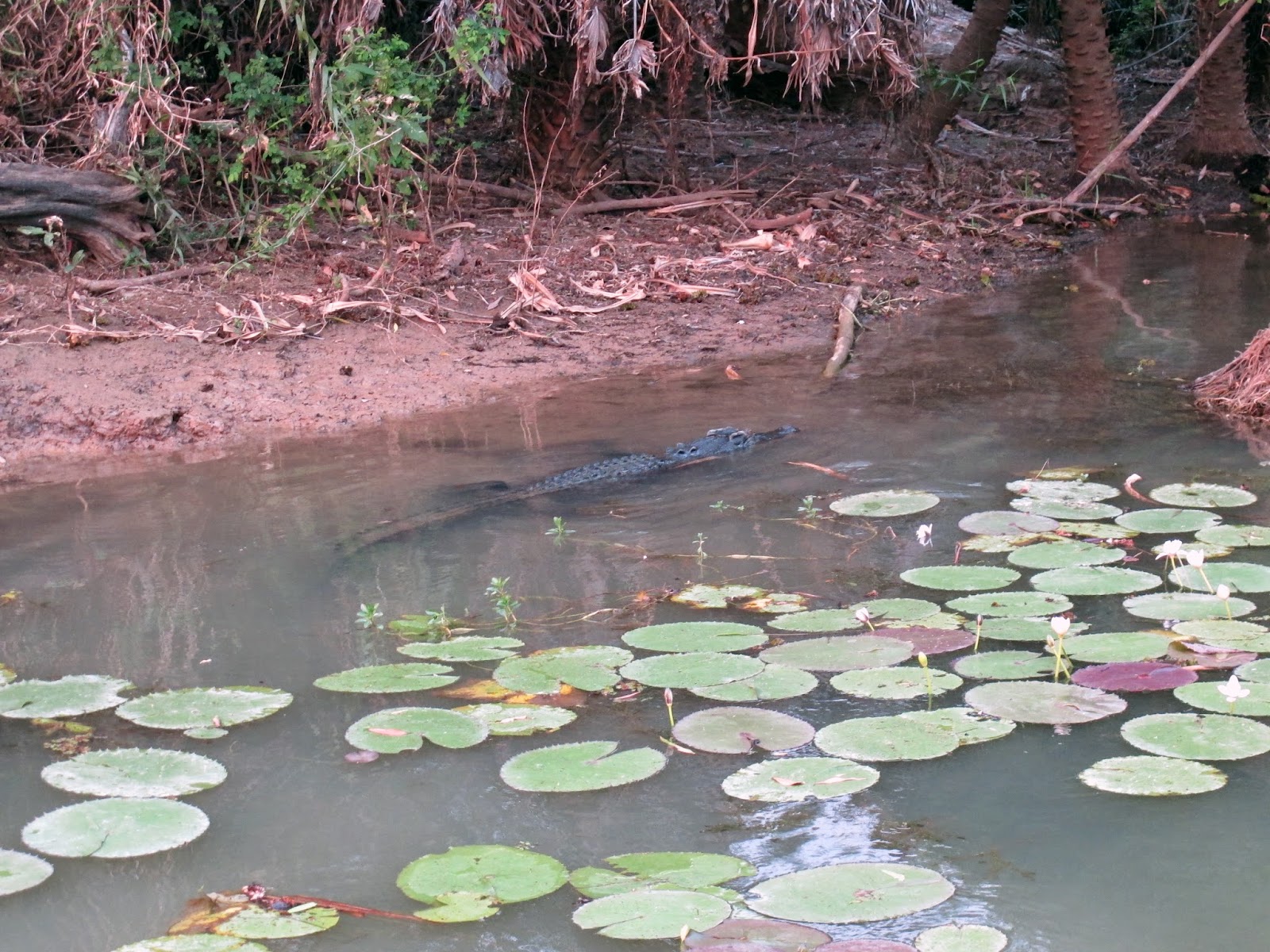
A lone male estuarine croc patrolled his territory. Top of the food chain, he guarded his many smaller females, daring us to come closer.
Male estuarine crocodile, South Alligator River
Come any closer and I'll let you know who is in control here was the message we received. We backed off!
A Four metre long saltwater crocodile
Male Estuarine Crocodile, South Alligator River
One of his harem wasn't that keen to see us either!
Female estuarine crocodile, Kakadu National Park

Female Saltwater Crocodile
This lady became decidedly cranky and suddenly turned, snarling, her awesome jaw letting us know to back right off!
Lotus on Yellow Water, Kakadu

Lotus

At the height of the wet season lotus flowers bloom thickly. There were still some vibrant patches left for us to enjoy.

As the sun slowly descended, allowing the crocodiles to hide in the darkened water our spectacular cruise came to an end!
Sunset on South Alligator River, Kakadu
What a great start to our Kakadu experience!

Monday, July 21, 2014

Mount Isa - a surprising city

Lack of internet connections, some long driving days and many days full of exploration and fun made it impossible to continue day by day blogging so the rest of the posts about this trip come from my diary and memory. 

I'll pick up the story at Mount Isa where we met our son, Rohan who joined us to share our holiday and to assist with driving. There were many nights on which he tossed up some great meals too. Accompanied by a glass of wine, eaten while seated under the balmy, clear and starry skies, these will be long remembered with appreciation and love.
Mount Isa, Queensland
Our first impression of Mount Isa was of a dreary town dominated by two high smokestacks set beside a black mountain of coal [?] and puffing out brown smoke. How dismal, we thought.How wrong we were! We had a few days here and the distinctly laid back air soon had us relaxing and forgetting time, the place began to be familiar and, by the time we came back on our way home, we felt some affection and appreciation of its uniqueness! 

The first thing we noticed was that the local people showed obvious pride and affection for The Isa and that community projects were regarded as of high importance. On arrival we were immediately roped in to participate in a weekly barbecue to raise money to buy feed bales for the farmers who were struggling to feed their stock during the current two year drought. On Show Day McDonalds was the only business open with the rest of the town totally deserted.

Many thousands of tourists pass through here but people were still very friendly and ready to help. Replacement of our badly cracked windscreen was accompanied by friendly conversation and sharing of the local's favourite places and activities, some of which we followed up.
Hard Times Mine - a tourist mine
One of the surprises was learning that Mount Isa is, according to the Guinness book of Records in 2012, the largest town in the world landwise. It takes in 43,310 square kilometres including the area to Camoweal 200 km to the north, and is larger in area than Switzerland. I wondered where the "Mount" was and learned that The Isa was named in 1923 by a mineral prospector John Campbell Miles after he was shown mineral deposits by an Aboriginal and thought the area would become like Mount Ida, a goldfield in Western Australia. Gold is not the mineral here though! Try copper, lead, zinc and silver! Vast deposits of these are now mined by a Swiss owned company but formerly by MIM - Mount Isa Mines, for whom the town was built.
Beef Cattle, Mount Isa
Prior to mining settlers had chased out the Kalkadoon people and tried farming this arid area. I was pleased to read that the Kalkadoon had actually successfully kept the settlers out for some years until 1884 when the were finally chased out by armed guards, their country effectively stole. My Opinion now, in 2014 when ethics and morals of such actions are regarded somewhat differently. I do, however, remember being outraged when watching the BBC newsreel on the last Friday each month and hearing how great it was the similar things had been achieved by the [then] mother country. I also remember getting into trouble for voicing my outrage!

It seems to me to be madness to still be trying to farm in this dry, harsh area. Many of the cattle we saw seemed emaciated and I wondered what the RSPCA would have to say had they been city animals. I do understand that families who may be tired of the struggle to raise stock cannot leave land they have held for a hundred years and would face economic ruin if they did so. What an un-winable situation.


Lake Moondarra, Mount Isa
Water supply is always a very serious issue here. In 1958 the Leichhardt River, which occasionally flows through the city, was dammed to obtain water principally for MIM.  This dam gave the local people storage for their drinking water and also a very popular recreational spot, Lake Moondarra. It is a favourite spot for fishing with the lake being stocked with barramundi and the like and is the venue for an annual Fishing Classic competition. Water sports are very popular however I wouldn't like to swim in the water after hearing about a water snake swallowing a one metre fresh water crocodile earlier in the year!  Freshies are usually disinterested in people however the snake may not be, especially if the person is not so tall! 

The lake was surprisingly big - something not obvious in my photo. It had very much shrunk from covering its 23 square kilometres, was at less than 30% capacity and covered with blue-green algae. Although the nights were cool the daytime temperatures reached 30C so the evaporation rates would be significant.
North to Camoweal
Our travel plan was to head for Kakadu National Park so we hit the road north.


Camoweal
Distances are unimaginably great in this part of the Queensland and their are few places to stop either to take a photo of an interesting scene or to take a rest. It pays to know before you travel just where it is possible to stop for a break. I used two books Budget Camps in Australia www.exploreaustralia.com.au and Camps Australia Wide www.campsaustraliawide.com together with the very comprehensive and up to the minute www.caravancaravan.com.au so we were able to plan our day's drive. This was fortunate as the Queensland signposting is not as good as we have found in other states.


Rest Stop
Some rest stops were merely pull ups with a rubbish bin while others provided amenities and were popular with the grey nomads for free overnight camping. Hardly camping though when you are pulling the equivalent of a small house complete with washing machine!

With two drivers, we pushed along the 640 kms to Three Ways where we spent the night camped behind the Roadhouse. The next day we did about the same number of Kilometers to Katherine. Kakadu began to seem real and close! 

Next Post Kakadu!

Thursday, June 19, 2014

Barcaldine to Winton

After Barcaldine, we travelled towards the never ending horizon. Although we did not see many oncoming vehicles, I was wary of stopping to take photos in case there was a car right behind me, something not that easy to see behind our little caravan.

Every hundred or so kilometres there were convenient pull overs where we could stretch our legs and have a snack. Only a few of these had facilities and all were in flat and devoid of shade. The lack of shade did not concern us at this time of the year however the wind was biting, despite the sunshine.

The flat landsacpe was not at all boring as we played dodge the dead kangaroos.


There were so many kangaroo carcasses on the road - and even that of a black, wild boar. The crows feasted on the older ones while the eagles preferred the fresher kill. As we neared they rose from their meal to soar around the area until we had passed.

Flat and dry was the norm here however the types of grasses varied.


Today's drive was a short one so once we were unhitched at our campsite we set off back down the track for five kilometres and then down an extremely dusty and corrugated road to see the famous Winton dinosaurs.


This is one of many parts of a new type of long necked dinosaur that has been found in the area. The round hole is the spinal nerve canal.


Digging up the dinosaurs and all the work that goes into putting them together and identifying them is done by volunteers. The dig lasts for only two weeks each year because in that time they find more than enough pieces to keep everyone busy for more that two years. Volunteers over the age of eighteen may assist in the dig. What a great work experience activity that would be for senior students! Other volunteers can work at any time doing the fine work as in the photo above. Training is provided and a certificate of competency issued and after that you can work as long as you like coaxing the dinosaur bones out of the rock. Apparently grey nomads make it part of their travel experience.

From The Big jump, Winton
The view from the "Big Jump" ie dinosaur mountain was spectacular. Easy to see the mighty Lake Eyre Basin - or part of it.

Wednesday, June 18, 2014

Brisbane to Barcaldine

Our first two days on the road have seen us hurry along more than usual because we need make up for our delayed departure. We need to be in Mount Isa in a few days time. Despite this time constraint, we chose to take a more interesting but more challenging drive than a direct line up the Bruce Highway would have been. We took the D'Aguilar to Yarraman and then turned onto the Burnett stopping at Biloela for our first night.

The Burnett is an easy road to drive as well as being interesting with hilly parts as well as flat stretches. We stopped for lunch beside the Burnett River at Gayndah.

 
While researching for this trip I gained a lot of useful information from many dif.ferent on the road blogs so I will include some information that may be useful to other travellers. We arrived at Biloela a little ahead of dark and easily found the Discovery Holiday Park on Valentine Plains Road. While we didn't see much of the Park, the staff were very helpful finding us an ensuite site, the drive through sites being full.

After an early start the next morning we were soon zipping along  the Capricorn Highway, stopping for brunch at the roadhouse at Duaringa. On other trips we learned not to order a meal each and again, one big breakfast between the two of us was more than enough! So fortified, we carried on to Emerald where we visited the Information Centre on the western side of the town. We had been there on a previous trip and, again, the information on offer was excellent.

Onwards we went, stopping briefly at Alpha for diesel and a quick cup of tea at a lonely roadhouse. The facilities here were excellent and inccluded showers.

Our arrival at Barcaldine, after another day of travelling over 600 kms, was again just before dark. I soon learned that it is pronounced Bar-cal- din or Barky for short!
Tree of Knowledge, Barcaldine
Barcaldine is famous for the Tree of Knowledge, a Ghost Gum, now dead after being poisoned in 2006. It is a symbol of the 1891 Shearers Strike which gave birth to the Australian Labor Party.
Barcaldine
This C pattern windmill was built in 1917 and erected on the first free flowing bire east of Barcaldine. the slightest puff of wind will move the 27ft [ 8 metre] blades.

Tomorrow we move on to Winton, our next stop.

Friday, June 13, 2014

A Camping Road trip from Brisbane to Kakadu, Litchfield National Park, Katherine and Lake Argyle

Fifteen years  ago I planned an estimated year long road trip right around Australia but before we could get organised for departure a different adventure presented itself to us, the  Grandparent Adventure.  Now that our grandchildren [the two that live nearby] are older and going on an overseas family holiday adventure of their own, we will soon leave our home comforts for a brief life on the road, one a little less than of a couple of months instead of a year.
Fifteen years has made a difference in what we are able to achieve with activities such as mountain climbing and strenuous walking now definitely out of the plan. Coping with cold weather and very long days of driving now that only one of us drives will also now be a challenge as will being sure that we have more than enough of medicines needed for all contingencies. The circumnavigation of our country is just too hard so we have chosen just one part of this huge land to explore. The blue line on the map indicates our expected outward trip with a slight variation in green being the homeward  one.
Charlie, the Teardrop trailer
We are so lucky to have three great adult children who encourage us in our adventures. This time our son is to join us from Mount Isa to share the holiday with us and to assist with some of the driving. This would not be possible for him to do  without the love and support of our daughter by marriage who will be home alone with their very energetic and articulate two year old son while also working full time and dealing with the building of their new home. That's love and generosity in action.

Part of our preparation for this trip was to go down to Canberra to pick up Charlie, the "trailer." He was built by our son while he was living in America and is a comfortable large bedroom on wheels together with a compact kitchen under the back hatch. 

The drive from Canberra was my first ever towing experience so now I have a few kms under my belt, as they say. I haven't yet had to reverse it into a confined space so that challenge is to come!

For this trip we have to be able to be totally self sufficient if we are to be flexible and able to stop in interesting places and also to avoid long days of driving. This means carrying far more water than usual as well as a Porta Potty! As well as that we have extra spare wheels, fuses and so on. 

Charlie's kitchen
I have found www.caravancaravan.com.au a useful website for traveller reported information about the facilities and conditions of places where we may stop, either briefly or overnight. Other travellers' blogs have also been both fun to read as well as giving some useful tips. I am ready to try out the one mentioned to repel hovering mossies  by spraying Listerine mouthwash on the chairs! My travel plan is a book in its own right - a day by day journey in detail. Hopefully it will have all the information we need to travel comfortably!

Now that we have recovered from the bug that got us during the past two weeks [ Influenza B ?], have dealt with the insurance company after the break in, had the security door that was removed from its tracks attended to and cleaned up the mess left by the intruders, we will soon be on our way. 

[Any would-be crims please note that not a thing of value is now on our property and that a security company is engaged in surveillance. The Very Observant Neighbour has also returned from her own holiday and is also on surveillance duty, police number at the ready. The police will also be cruising around at least three times daily.]

We're almost ready to depart. Let the last of our camping adventures begin!

Monday, May 26, 2014

A Hindu wedding in Sydney

We've just returned from a very pleasant few days in Sydney and Canberra. In Sydney we were honoured to attend the wedding of a friend's daughter. This was a very interesting occasion as the marriage involved not one but two separate ceremonies on consecutive days. The first ceremony was the Sinhalese Poruwa ceremony. Buddhism was repeatedly mentioned during this ceremony by the Sri Lankan celebrant who seemed to say that he was conducting the ritual on behalf of the clergy. I have attended many such ceremonies and have not previously understood that this was the case. In fact the Buddhist clergy are not supposed to have anything at all to do with marriages and weddings - not that such a rule got in the way of one monk I know of who made a lot of money out of arranging marriages until outrage finally saw him get into trouble. [Ordination rules also prevent Buddhist monks from touching money, too.] Anyway, as we also had a Poruwa wedding coming up to fifty years ago, I really enjoyed the memories it brought back. Unfortunately the bright lighting behind the poruwa and the fact that I could not get a good position means that I don't have even a half decent picture.
Hindu Temple, Sydney
The next morning saw us at a Hindu temple for the second ceremony. This was my first Hindu wedding and I think the ceremony has similarities with the Sikh weddings I have attended. Unlike in the Poruwa ceremony, only the groom was asked if he agreed to the marriage - an interesting difference I thought.
The bride's sister looked especially lovely in her colourful sari.

At the auspicious time the groom entered followed by his family. We then had to wait until it was the auspicious time for the bride to join him under the canopy.


As soon as the bride was seated on the groom's right the ceremony began.


At the end of this interesting and colourful ceremony we joined the long line of guests to offer our blessings and have our photo taken with the newly married couple.