Wednesday, September 10, 2014

Ubirr, Kakadu National Park

For the last days of our time in Kakadu we moved to Kakadu Resort in Jabiru to make it easier to explore the East alligator region. Covering almost 20,000 square Kilometers,  Kakadu National Park is about eighty percent savannah woodlands and also encompasses wetlands, rainforests, billabongs, floodplains, coastal beaches, escarpments and . . . the Alligator Rivers, South, West and East. There are no alligators in Kakadu! The rivers were named in 1818 by one Phillip Parker King, a seemingly unimaginative Englishman who mistook the crocs for alligators.

 Ubirr, forty two kilometers from Jabiru, is in the East Alligator region and borders on Arnhem Land. It is the traditional lands of the Bunidj, Manilagarr, Murrwan and Mandjurlgunj people. Our guide,  young Aboriginal man who lives on his traditional land, quietly met us at the beginning of the track and that was the start of a deeply moving experience for us. What knowledge, humility, respect for his country and people, what patience in dealing with thoughtless questions he displayed. His dignity and maturity was an example to all.
An inspirational young guide
At the end of  his presentation I asked if I could take his photo the young man said he wanted one with me. Although I hate having my photo taken I could hardly refuse. I show it now, at the beginning of my story because this young man had a profound effect on many of us on this day.

It was with pride that he explained that his clan was represented on the Land Council that was ensuring that his country was being respectfully cared for and being shared with all who came to explore it and to learn about its ways. He explained that one of his clan was a member of this council and that one day his own turn would come to take on that responsibility. I am sure that he will do a great job when his time comes.

What a spellbinding story teller he was! Most of the large group were captivated with the images he evoked with his soft, thoughtful language and careful indication of where to look to see the characters he was describing. The stories he told were of a cautionary nature, illustrating why the people needed to abide by the clan laws and what would happen to them if they didn't. As he talked I realised how important these laws were for the survival of the families who were reliant on nature to provide for their every need as well as to guard against the dangers their country held for them.

One area was an outdoor classroom area where children were taught the laws of their clan and the land.
Mabayu
The photo above is a painting of Mabayu. You can see his spear, dilly bag and spear thrower. His story is a cautionary one about the consequences of sneakily taking something that does not belong to you and it was told something like this. I will try to tell it as it was told to us.

One day Mabayu was fishing near the East Alligator river. It was a good day. There were many fish and as he caught each one he placed it carefully on a pile on the river bank. A greedy person was watching this and, when Mabayu was not looking she crept up and stole all the fish. Mabayu came up from the river and saw his fish were gone. He went looking for them and smelled them cooking on a fire in a cave. He hid and watched all the people eating his fish. That night he blocked the entrance to the cave with a big stone and all the people were shut inside. No one could get out. Not one. So, behave properly and do good behaviour. Don't take anyone else's fish.
Battle between clans
Then there was the story of the girl who ate Barramundi at the wrong time, breaking the traditional laws. When she was punished too severely there was a battle between the clans and many, many people died. So, don't do the wrong thing or many other innocent people may suffer your consequences. A common punishment was to be speared in the leg. This would be life threatening not only because of infection but because the person would not be able to move around to be safe from harmful things or to find food and water.
Barramundi. Paintings were often done on top of others. We were told that the painting itself was not as important as the act in creating it.
Then there were the two Mamarrgarn Sisters who were playing string games down by the river. One of them stood in the water at the mouth of the East Alligator River. She knew how to turn herself into a crocodile, so she did. Then she turned herself back to a sister.

Her sister was watching and she asked, "Can you show me how to do that?" 

So they went to a fresh water spring and the second sister learned how to turn into a crocodile. Then they both changed into a saltwater crocodile and stayed like that. Nowadays there are palms around that spring grew from the sister's teeth which they pulled from their mouths and planted. As crocodiles the sisters always know where their food is because of the large ridge scales on their backs. They are special sensory powers that tell where dinner is, even under water.

Long Necked turtle, Kakadu Dreamtime story

Another story that held us spell bound until the final words was that of the long necked turtle and the echidna. Here it is, again told as closely as possible as it was to us.

In our Dreamtime a long necked turtle and an echidna were good friends who lived together. They hunted together and shared their food. The echidna had a little one, a baby. One day they ran out of food so the echidna told the turtle to stay and keep the little one while she went hunting further away. So she went and the turtle stayed with the little one.

The echidna was gone a long, long time and the turtle was very hungry. After a while he was so hungry he ate the little one. Then the echidna came back with some food.

"Where is my little one?"she asked.

"I was so hungry that I ate it,"said the turtle.

The echidna was so angry that she went to get stones to throw at the turtle. The turtle got spear grass and threw it at the echidna. They had a big fight. After that the stones turned into a shell on the turtle's back and the spear grass turned into spines on the echidna. 

Then the turtle told the echidna, "I will go and live in the billabong and never see you again."

The echidna said, "I will go and live up in the escarpment and never see you again."

They did that. Now, when we eat turtle we find the little echidna's bones in the turtle's throat.

If I retell any more of the enthralling stories told to us so beautifully this post will be very long!

Mimi Spirits
 Some of the paintings are high on the escarpment. The Mimi Spirits were Dreamtime ancestors who were the first to draw rock paintings and taught the people. Some of them entered the rock as paintings themselves and the places where this happened are sacred places, visited only by a few permitted people.

Tassie Tiger - Thylacine
Other lofty paintings record now extinct animals that must have been common to the area. the Tassie Tiger is one of these.

Over the centuries the weather elements have assaulted the paintings with some visibly losing colours. The ridge line visible in the above photo is a resin ridge that guides rain water along it and down the side of the rock face instead of falling down over the paintings, destroying them.

 Our guide told us that only special people within his clan were allowed to do the painting, each one permitted to do only a certain part. He himself is permitted to do only the lines using a thick brush, not the finer details. He picked up pieces of rock that could be crumbled to make a fine powder, sometimes reddish and sometimes yellow. "This here rock powder is then mixed with a resin from a plant so that it sticks to the rock for a long, long time," he said.

Ubirr, Kakadu National Park
Storytelling finished, our guide had us clamber up some steepish rocks to a small plateau that allowed us to look back at the caves where we had had the privilege of  seeing the paintings and hearing their stories.

After telling us that in the wet seasons of Gudjewg and Banggerreng he travels around the area below by boat, our young guide left us but not before we were thanked for visiting his country and for listening to the stories of his people. As he was saying his last words I was pleased that Rohan made his way down the rocks to shake this awesome young man's hand and even more pleased to see everyone else do the same. Our time with him was so precious that the usual applause would have been way less than adequate or respectful.
From Ubirr, Kakadu National Park

Ubirr is right on the border with Arnhem Land, seen behind us in this photo.

Our time in Ubirr, hearing the stories of the land and its people from a young man who is so very proud of his heritage was a very spiritual experience, to be remembered always.

Saturday, August 16, 2014

Nourlangie Rock and Anbangbang, Kakadu National Park

Approach to Nourlangie, Kakadu National Park
Our second day in Kakadu was spent at Nourlangie and this was where we began to acquire a greater understanding of Aboriginal culture and to appreciate, in a more informed way, the deep connection the First Peoples of this land have with it.  Contrasted with other world ideas of ownership of land and the drive to maximise its value, we saw that, to the Aboriginal people, the land is a living entity that could be said to own them. We saw their deep and abiding connection to it and their belief that they must respect, revere and protect it or it will suffer from neglect which will, in turn, have severe repercussions for them.
Nourlangie Rock, Kakadu
"Nourlangie", an anglicised version of Nawurlandja, is actually the name given to the larger area while the lower areas are known as Anbangbang. We went to the three main areas of Burrungguy, the name of the upper part of the rock. The smoke in the photo above is from a naturally occurring fire near the Anbangbang shelter.
Namarrgon Djadjam
The photo above was taken from Gun-warddehwarddhe Lookout. The cliffs are part of the Arnhem Land escarpment and are a sacred site, not to be disturbed.
Nourlangie Rock
This area, with its extensive woodlands, wetlands, creek and cliffs offering plenty of food opportunities, would, in prehistoric times, been home to many people. Artefacts and implements uncovered when layers of soil were excavated in the 1980s indicate that the caves here were in use 20,000 to 6,000 years ago. Aboriginal people say that this area was used by the Warramal clan, traditional owners of the land and also by the Badmardi clan who came down from their higher area to get food from the billabongs and woodland areas. Now that the Warramal clan has died out the Aboriginal owners from neighbouring areas have taken on the responsibility for this area. This was carefully and respectfully explained to us by the young Aboriginal guide.
Anbangbang
At Anbangbang the rock paintings have several purposes- some tell cautionary stories which encourage the keeping of clan rules while others simply depict celebrations.
Nabulwinjbulwinj
Nabulwinjbulwinj is a very fearsome spirit for women. He knocks them out with a yam and eats them. I couldn't find out why women were at risk and how they could avoid this fate but I am sure such a threat would have been enough to ensure good behaviour.
Lightning Man, Namarrgon, and Namondjolg
Lightning Man, Namarrgon, is a very important creation spirit who even today creates the violent lightning and thunderstorms that bring the lifesaving rains. With his lightning band looping from his left ankle through his head and hands down to his right ankle and his thunder cracking axes on his elbows, head and feet I thought that he looked like he would enjoy making an entrance after the protracted dry times! 

The big form beside him is that of Namondjok but first lets see Lightning Man's wife, Barrginj. She is the figure below Namondjok. Barrginj [ Barr-jeen] is important because she is the mother of the Alyurr, the grasshoppers. These grasshoppers are important because, in the creation time, they gave the Aboriginal people their language, beliefs, values and structure of their society. The Alyurr, the amazingly beautiful blue and orange grasshoppers, are rarely seen today however they are said to appear just before the wet season when they call to their father, Lightning Man, to bring stormy relief to the people and the parched land.

Now back to Namondjok. While there are different stories about this same spirit ancestor, our guide explained that Namondjok broke clan rules by marrying unlawfully. Aboriginal laws dictate whom people may or may not marry and this is a cautionary tale that reminds people of the clan rules about marriage. Now, in Aboriginal clans a sister does not necessarily mean one's sibling but includes their first cousins on both sides of the family and also some other less clear relationships. Anyway Namondjok married his sister and was transformed into an estuarine crocodile. Other clans tell that Namondjok is an ancestor who now lives in the sky and is seen only at night near the Milky Way.
Namondjok's feather
After Namondjok married his sister she took a feather from his headdress and placed it on the rocky outcrop to show others what they had done. She then became a rainbow serpent.
Some of the art work at Anbangbang cave has been repainted many times and this shows the conditions, events and animals of the time of the repainting.
Anbangbang
Anbangbang
Anbangbang
The kangaroos we saw in the National Park were smaller than this one and often a greyish colour.
Anbangbang
Anbangbang Billabong is a kilometre or so from Nourlangie Rock. As the circular walk was closed due to the presence of crocodiles, we had to be content with enjoying lunch at one of the picnic tables. While sitting there peacefully I reflected on how resourceful and resilient the Aboriginal people there had had to be to live successfully in a beautiful but sometimes difficult environment. I also appreciated how fortunate we are to be able to gain an understanding of a culture that persists in surviving despite great difficulties having been dropped on it.
Anbangbang Billabong late June

Saturday, July 26, 2014

Sunset Cruise on South Alligator River, Kakadu National Park

 The number one focus of this trip was to explore Kakadu National Park and, having now travelled almost four thousand kilometers, our anticipation heightened! After refuelling at Pine Creek we entered the National Park via the Kakadu Highway.

This was a very different National Park to those I had visited in other States and countries. Here the vegetation alongside the road was bare and blackened with fires still burning unattended in many places.  Burned black tree trunks with green heads standing on the bare sooty earth made a striking picture. The smell of bush smoke waved past our senses.  Even though this was only the beginning of the dry season, the grasses had a dry yellow hue giving a scorched appearance. I later learned that it is the practice to burn off the park in a mosaic pattern every three years. This minimises major spontaneous fires and also allows those plants that require fire for regeneration to thrive. We planned to try bush style camping instead of the commercial caravan parks so we were pleased to find that our chosen camp site was well away from any fires.
Mardugal Camp, Kakadu
Our first real camp proved to be the highlight camp of the whole trip! Mardugal is a non commercial  camp managed by the National Park Board and had bush luxuries such as showers with hot water -  thanks to the solar system. Trees provided shade and there were grassy areas where one could pick a spot and set up camp untroubled by close proximity to neighbouring campers. We loved the environment, meeting other travellers and also the Ranger's evening talks and walks in this woodland area.
South Alligator River, Cooinda
By early afternoon we had set up our camp, had lunch, chatted to a few other campers so we decided to take a drive to Cooinda to obtain our National Park passes. That done, we went for a drive to get a feel for the Park so that we could plan for our upcoming activities. 

Kakadu, and also the rest of the Northern Territory, proved to be full of surprises! One minute we were driving down flat dry sided roads when, suddenly, we found ourselves confronted by an amazing sight of water - either a river, billabong of a waterfall! We were soon out of the van and taking the boardwalk from the Yellow River cruise boat ramp. How still and quiet it was! And how beautiful!  We knew that we couldn't wait another day to take a cruise through this amazing place! Back we went to book our sunset cruise which would depart in little over an hour.


South Alligator River, Kakadu National Park


Sunset Cruise, Yellow Water
My photos do not do justice to the incredible number of different birds that are currently gathering here as the monsoonal waters recede.
Cormorant
Nankeen Night Heron

There were many egrets, lazily named small, medium or big.

Pied Cormorant


The calls of Whistling Ducks that have begun flying in as the water elsewhere in the Territory dries up accompanied us as we slowly floated downstream. In a few weeks their numbers will be in the tens of thousands.


The sun was going down with the smoke influenced light changing  colours minute by minute.
Yellow Water Sunset cruise
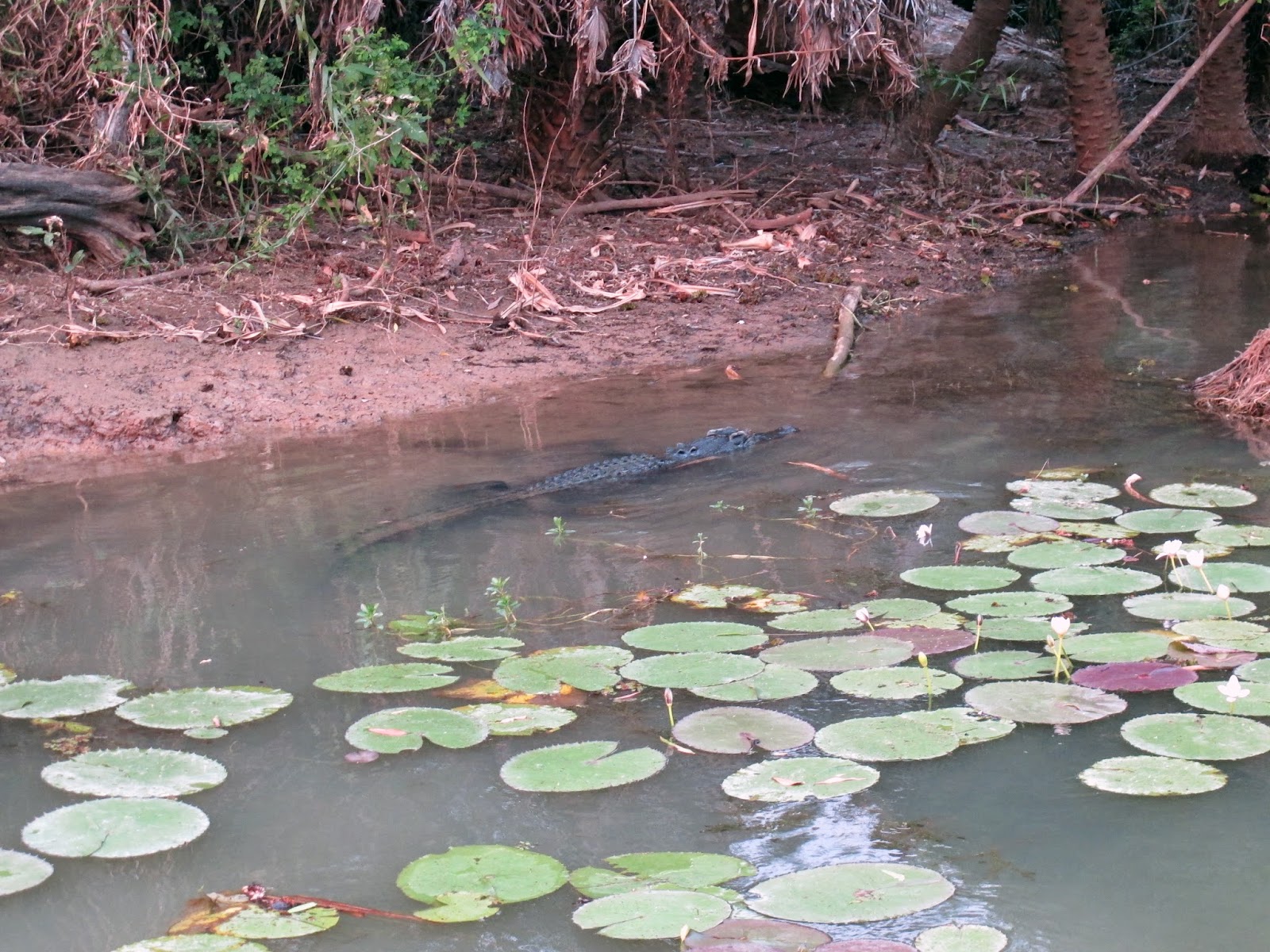
A lone male estuarine croc patrolled his territory. Top of the food chain, he guarded his many smaller females, daring us to come closer.
Male estuarine crocodile, South Alligator River
Come any closer and I'll let you know who is in control here was the message we received. We backed off!
A Four metre long saltwater crocodile
Male Estuarine Crocodile, South Alligator River
One of his harem wasn't that keen to see us either!
Female estuarine crocodile, Kakadu National Park

Female Saltwater Crocodile
This lady became decidedly cranky and suddenly turned, snarling, her awesome jaw letting us know to back right off!
Lotus on Yellow Water, Kakadu

Lotus

At the height of the wet season lotus flowers bloom thickly. There were still some vibrant patches left for us to enjoy.

As the sun slowly descended, allowing the crocodiles to hide in the darkened water our spectacular cruise came to an end!
Sunset on South Alligator River, Kakadu
What a great start to our Kakadu experience!

Monday, July 21, 2014

Mount Isa - a surprising city

Lack of internet connections, some long driving days and many days full of exploration and fun made it impossible to continue day by day blogging so the rest of the posts about this trip come from my diary and memory. 

I'll pick up the story at Mount Isa where we met our son, Rohan who joined us to share our holiday and to assist with driving. There were many nights on which he tossed up some great meals too. Accompanied by a glass of wine, eaten while seated under the balmy, clear and starry skies, these will be long remembered with appreciation and love.
Mount Isa, Queensland
Our first impression of Mount Isa was of a dreary town dominated by two high smokestacks set beside a black mountain of coal [?] and puffing out brown smoke. How dismal, we thought.How wrong we were! We had a few days here and the distinctly laid back air soon had us relaxing and forgetting time, the place began to be familiar and, by the time we came back on our way home, we felt some affection and appreciation of its uniqueness! 

The first thing we noticed was that the local people showed obvious pride and affection for The Isa and that community projects were regarded as of high importance. On arrival we were immediately roped in to participate in a weekly barbecue to raise money to buy feed bales for the farmers who were struggling to feed their stock during the current two year drought. On Show Day McDonalds was the only business open with the rest of the town totally deserted.

Many thousands of tourists pass through here but people were still very friendly and ready to help. Replacement of our badly cracked windscreen was accompanied by friendly conversation and sharing of the local's favourite places and activities, some of which we followed up.
Hard Times Mine - a tourist mine
One of the surprises was learning that Mount Isa is, according to the Guinness book of Records in 2012, the largest town in the world landwise. It takes in 43,310 square kilometres including the area to Camoweal 200 km to the north, and is larger in area than Switzerland. I wondered where the "Mount" was and learned that The Isa was named in 1923 by a mineral prospector John Campbell Miles after he was shown mineral deposits by an Aboriginal and thought the area would become like Mount Ida, a goldfield in Western Australia. Gold is not the mineral here though! Try copper, lead, zinc and silver! Vast deposits of these are now mined by a Swiss owned company but formerly by MIM - Mount Isa Mines, for whom the town was built.
Beef Cattle, Mount Isa
Prior to mining settlers had chased out the Kalkadoon people and tried farming this arid area. I was pleased to read that the Kalkadoon had actually successfully kept the settlers out for some years until 1884 when the were finally chased out by armed guards, their country effectively stole. My Opinion now, in 2014 when ethics and morals of such actions are regarded somewhat differently. I do, however, remember being outraged when watching the BBC newsreel on the last Friday each month and hearing how great it was the similar things had been achieved by the [then] mother country. I also remember getting into trouble for voicing my outrage!

It seems to me to be madness to still be trying to farm in this dry, harsh area. Many of the cattle we saw seemed emaciated and I wondered what the RSPCA would have to say had they been city animals. I do understand that families who may be tired of the struggle to raise stock cannot leave land they have held for a hundred years and would face economic ruin if they did so. What an un-winable situation.


Lake Moondarra, Mount Isa
Water supply is always a very serious issue here. In 1958 the Leichhardt River, which occasionally flows through the city, was dammed to obtain water principally for MIM.  This dam gave the local people storage for their drinking water and also a very popular recreational spot, Lake Moondarra. It is a favourite spot for fishing with the lake being stocked with barramundi and the like and is the venue for an annual Fishing Classic competition. Water sports are very popular however I wouldn't like to swim in the water after hearing about a water snake swallowing a one metre fresh water crocodile earlier in the year!  Freshies are usually disinterested in people however the snake may not be, especially if the person is not so tall! 

The lake was surprisingly big - something not obvious in my photo. It had very much shrunk from covering its 23 square kilometres, was at less than 30% capacity and covered with blue-green algae. Although the nights were cool the daytime temperatures reached 30C so the evaporation rates would be significant.
North to Camoweal
Our travel plan was to head for Kakadu National Park so we hit the road north.


Camoweal
Distances are unimaginably great in this part of the Queensland and their are few places to stop either to take a photo of an interesting scene or to take a rest. It pays to know before you travel just where it is possible to stop for a break. I used two books Budget Camps in Australia www.exploreaustralia.com.au and Camps Australia Wide www.campsaustraliawide.com together with the very comprehensive and up to the minute www.caravancaravan.com.au so we were able to plan our day's drive. This was fortunate as the Queensland signposting is not as good as we have found in other states.


Rest Stop
Some rest stops were merely pull ups with a rubbish bin while others provided amenities and were popular with the grey nomads for free overnight camping. Hardly camping though when you are pulling the equivalent of a small house complete with washing machine!

With two drivers, we pushed along the 640 kms to Three Ways where we spent the night camped behind the Roadhouse. The next day we did about the same number of Kilometers to Katherine. Kakadu began to seem real and close! 

Next Post Kakadu!