Showing posts with label sri lanka. Show all posts

Friday, June 26, 2015

Pearl of the East, Serendib, Taprobane, Sri Lanka. Home.

The chattering of monkeys and sounds of bird call broke through the last moments of my sleep. With eyes half open, I realised that this was the last morning for many months, maybe even a year, that I would awake to the beauty of early morning at Olu Ella. Out I went to the balcony where I watched the slow sun slide through the trees and flash on the white head feathers of fantails as they darted among branches. Other birds called their friends to get moving, to begin their day long food search. 

Olu Ella Inn balcony
There was no need to search for food on my part! I could hear the sounds of people below me as they began preparations for our breakfast. As it was our last breakfast we were sure to be presented with an elaborate one! I decided to go down to meet the day so, after "Good Morning! "to everyone, I went down the steps to the river below. There I sat beside the calm swimming hole watching the yellow bulbuls darting to pick off the insects caught in the new sunlight. I love to sit here, feet in the quiet waters, watching the flowing water find its way through the huge rocks and becoming a fierce rush of white water just a few metres downstream. 

I knew that today this beautiful place would be enjoyed by city dwellers making a weekend escape from the pollution of Colombo by visiting our guesthouse -home to play in the river, enjoying the cool, refreshing water before sampling the traditionally cooked dishes that have earned the guesthouse many recommendations.  
Visitors enjoying the We Oya at Olu Ella Ella Inn
I decided to leave the river today for our visitors to enjoy and made plans to spend the day with a slow trip down the road stopping to take photos at my favourite points. Usually, when we leave home we are moving to a timetable and there's no time to stop for photos. Today I would go alone and stop wherever I pleased! A phone call confirmed that a tuk tuk was available so, after breakfast of freshly made egg hoppers - always my favourite Sri Lankan breakfast - I took my camera and walked down our path to the bridge.
Our Sri Lankan home. Olu Ella Inn
Set among the tea and rubber trees our home is in a hill side village where tea and rubber, together with cardamons and cloves in season, are the income earners for the villagers.
Tea and Ribber trees
Then it was a practiced walk over the high bridge . . .
Bridge over We Oya, at Dombepola

. . . with a pause to take a photo looking downstream . . .
Down stream We Oya from Dombepola bridge

and upstream.
upstream We Oya, Dombepola bridge and after heavy rain.
About five hundred metres along the road is Olu Ella Falls, the fifth highest waterfall in Sri Lanka. I have posted previously about this waterfall.
Olu Ella Falls, wet season
Olu Ella Falls, dry season
My tuk tuk was waiting! The young driver had been told that I wanted to take photos so, after only my first request to stop, he took to stopping wherever he thought a photo should be taken. He really loved his part of the world and stopped exactly where I planned!
Travel by tuk tuk
For the most part, the road is little more than one way only. We are all used to this and there's absolutely no road rage when there are delays with vehicles needing to back up. Instead people use the opportunity to shout news from passing tuk tuks or buses to friends going the other direction!


Seepoth Road, from Yatiyantota
First time visitors to our guesthouse often remark that just getting to our place is an adventure! They enjoy the drive along the windy road, adventures at every corner, through the tea and rubber plantations and the vistas that greet them at every bend.
Getting the day's tea pick ready for collection
Tea is everywhere. As the people usually have only a couple of acres of tea to farm the daily pick is collected by the local tea factories. How much per kilogram they are paid for these green leaves depends on the season but is usually between fifty to sixty rupees a kilogram. The pickers are paid about ten rupees per kilogram for their work so a lot of tea needs to be picked for anyone to earn a living.
Rubber trees, We Oya
Harvesting both tea and rubber is very much dependent on the weather. If there's rain, harvesting is impossible. In recent years there have been very long periods of drought in this area and the people have suffered accordingly. No harvesting equals no income.
Collecting the latex.
When I made my first trip along this road almost fifty years ago I was shocked to see cows little bigger than big dogs. Coming from New Zealand, this horrified me. Now, with breeding assistance from New Zealand, the cows I meet are very much bigger! And can be somewhat intimidating! This one did not agree to having her photo taken.
This area is in a rain corridor so, even on a day that starts out clear and sunny, clouds can appear and dump a bit of water before petering out and returning the sunshine. The hilltops often sit in front of a haze.
We Oya valley
In the wet season the hills are adorned with many high waterfalls. This year I noted that most had dried up, including some I have never known to do so.
Water falls We Oya
What a beautiful setting for the We Oya Rubber Estate's workers' accommodation!
We Oya Rubber Estate
All too soon it was time to turn around.  A phonecall informed me that the visitors had finished their water fun. My turn now!

I was soon back in the water, fish exploring around my feet looking for something to eat. . .
Asian Open Bill, Sri Lanka
. . . and watching the Asian Open Billed stork feeding from the rocks.


Asian Open Bill, We Oya, Sri Lanka
We Oya, Sri Lanka
What a lovely way to end my time in my Sri Lankan home!


Friday, January 3, 2014

Wadde and Karapincha [ Curry Leaf ] trees


We are having a really hot summer here in Brisbane this year with today’s extreme temperature reaching 41 Celcius so instead of being active we are hiding indoors, watching  tennis being played in the oven like conditions in the city, cold drinks on hand accompanied by our favourite Sri Lankan snack – wadde.

Wadde
Maybe you’d like to try some! They go well with any drink, wine or beer or Sri Lankan arrack – for me, mixed with a soft drink to soften the alcoholic content!


Here’s what you need:


2 cups of split peas

About 3 teaspoons of dried red and /or green chillies or freshly chopped ones

Some turmeric – just a pinch

Salt to your taste

1 thinly sliced red onion

Curry leaves cut into pieces [ Karapincha in Sri Lanka]
1 teaspoon fennel seeds
2 buds of garlic crushed


Here’s what you do:


Firstly you need to soak the split peas in water for at least 3 hours and then leave them to strain well in a colander. If not well strained your mixture may be too sticky.

You then process the peas in a food processor – blender. If you like chunky wadde you can reserve a couple of spoons full of peas to be added later. Once you have a paste, put it into a suitable bowl and add the chillie, sliced onions, turmeric, curry leaves and salt. Add the reserved peas now.

Wadde mixture ready to cook


Now it’s time to make the cakes by taking a small amount of the mixture and forming a ball with your hands. Flatten the ball in the palm of your hand to make a flattish cake. You can wet your hand with water or a little oil to prevent the mixture sticking to your hand.


Lastly cook the wadde a few at a time in deepish hot oil. Place on paper towel to absorb surface oil.


Ah! Memories of evenings in Sri Lanka sitting chatting with friends old and new sharing a plate of these tasty short eats dwell pleasantly in my mind!


Enjoy!


Karapincha tree Murraya koenigii

 While researching unsuccessfully for an alternative suggestion to curry leaves for those who don't have the benefit of a tree in their yard, I found out more about this essential tree which grows so well in my garden that it can be a bit of a problem.  No longer will I regard it as a nuisance as I try to sort out its unruly growth! Apparently it may soon be used to treat a type of liver cancer – hepatocellular carcinoma with in vitro tests looking promising, according to various googled sites. I should not be surprised as it is used often in Ayuvedic medicines in Sri Lanka. 

The Karapincha tree is native to Sri Lanka and India where it grows up to 6 metres. Thankfully, however, our tree would be only about 3 metres. The pinkish seeds turn blue -black and grow little trees very easily under the parent tree. The leaves are very aromatic and sweet so we use them in many of our dishes, simply picking some of the branchlets and stripping the leaves off in one movement.

Wednesday, November 6, 2013

Elephants- on the road and at Giritale National Park

From Trincomalee we took the A6 to Habarana, a distance of 88 km. I was surprised to notice electrified fences along the way, notably near Kantale Wewa. Realising they were there to keep jumbos off the highway I paid close attention to the scrubby bush, hoping that the cloudy day would bring at least one jumbo out early to feed. I was not disappointed! 

This lone jumbo paid little attention to us as he pulled up his grassy lunch and carefully popped it into his mouth. Elephants need to eat about 150kg of plants such as grass, fruit, leaves and the softer shoots of some trees each day so eating is a serious business for them. Clicking cameras are not worth the energy needed to be distracted from the eating ritual!
Sri Lankan elephant - elephas maximus maximus
This elephant, with his small ears fringed with depigmentation and curved spine, is a great illustration of the Sri Lankan elephant, one of three subspecies of the Asian elephant. Other body parts of the Sri Lankan elephant that often have depigmentation of the skin are the ears, trunk and face. I have also seen one with bands around his feet.

The road from Trincomalee to Habarana runs along side the railway line as far as Agbopura. We never have the time to travel by train or bus nowadays and, to be truthful, we do like to enjoy the relative comfort and flexibility of a vehicle. Those tourists keen to travel local style and to see elephants in the wild could come by train either on the Trincomalee line to Gal Oya and then take a tuk tuk to Minneriya or Kaudalla. There is also a station at Minneriya on the Batticaloa line. Here's one of the train timetable links.
http://colombofort.com/train.schedule.htm


Kaudalla, Minneriya and Giritale National Parks
The last time I saw elephants in the wild was late December in a flooded Kaudalla National Park. September is the dry season so the herds of elephants that roam between these three National Parks, connected by an ''Elephant Corridor" were concentrated in the one with the most water, Giritale.
Road into Giritale National Park
Happy that it was a rather dull, cloudy, moist day which would bring the elephants out of the bush early to feed, we had a delicious lunch at Hasthi Restaurant, Habarana,  hired a jeep and drove to Giritale National Park. There we bought a day visit permit - costs Rs 60 for local people, Rs 1945 for foreign visitors plus service charges and taxes of Rs 1900. The jeep hire this time was Rs6000, up from Rs5000 less than two years ago. As we were far earlier than the usual afternoon safari time of 3pm, the obligatory guide was waiting to get into our jeep. It turned out that his guiding was little more than a slight wave of the hand to confirm the jeep driver's intended direction for which we tipped him Rs500 at the end of the safari.
Elephants at Giritale, Sri Lanka
Our jeep driver, Channa, knew the area well and also had a great eye for spotting many birds - blue tailed bee eaters, bulbuls, ibis, egrets, herons, lapwings - and before too long he had found a grassy area surrounded by quite thick bushes. As we arrived this mother and baby emerged from an almost hidden gap in the bush and immediately began eating the green grass.
Mother and Baby elephant, Giritale
More elephants emerged until a herd of about twenty was occupying the open space.
Sri Lankan elephants at Giritale National Park
Elephants at Giritale National Park, Sri Lanka
We were the last of six jeeps in a line and, as the elephants came closer and began to pass very near the front jeeps, Channa decided to turn the jeep around so that we could move out of their way, should they decide to come this way.

As he was manoeuvring the jeep some of the elephants moved through the bush to another area.

One elephant decided to take a closer look at us.

We moved further away to the side of a river and were rewarded by the herd coming through to cross the river and return to the bush.

One young elephant clearly wanted to play longer in the water!
It was soon joined by some other babies who enjoyed a brief splash time while their mothers and aunties crossed to the other side and began to disappear into the trees.

Once again, one of the herd gave us a closer look
When the first baby into the water was the only one remaining in it, some aunties came back and gently nudged it with their trunks. Time to move on, darling!
Elephants, Giritale National Park
Obediently baby complied!
As we left we saw another herd coming through into the grassy area. Suddenly, one of them moved with surprising speed to follow our jeep. Channa moved carefully, trying not to rev the engine, hoping that the elephant would remain calm. After a few metres it turned its attention to a jeep behind us. Lucky that Channa had turned us around!
Fisher Eagle, Giritale
As we moved away, Channa spotted this Fisher Eagle hidden in a tree overlooking the river.

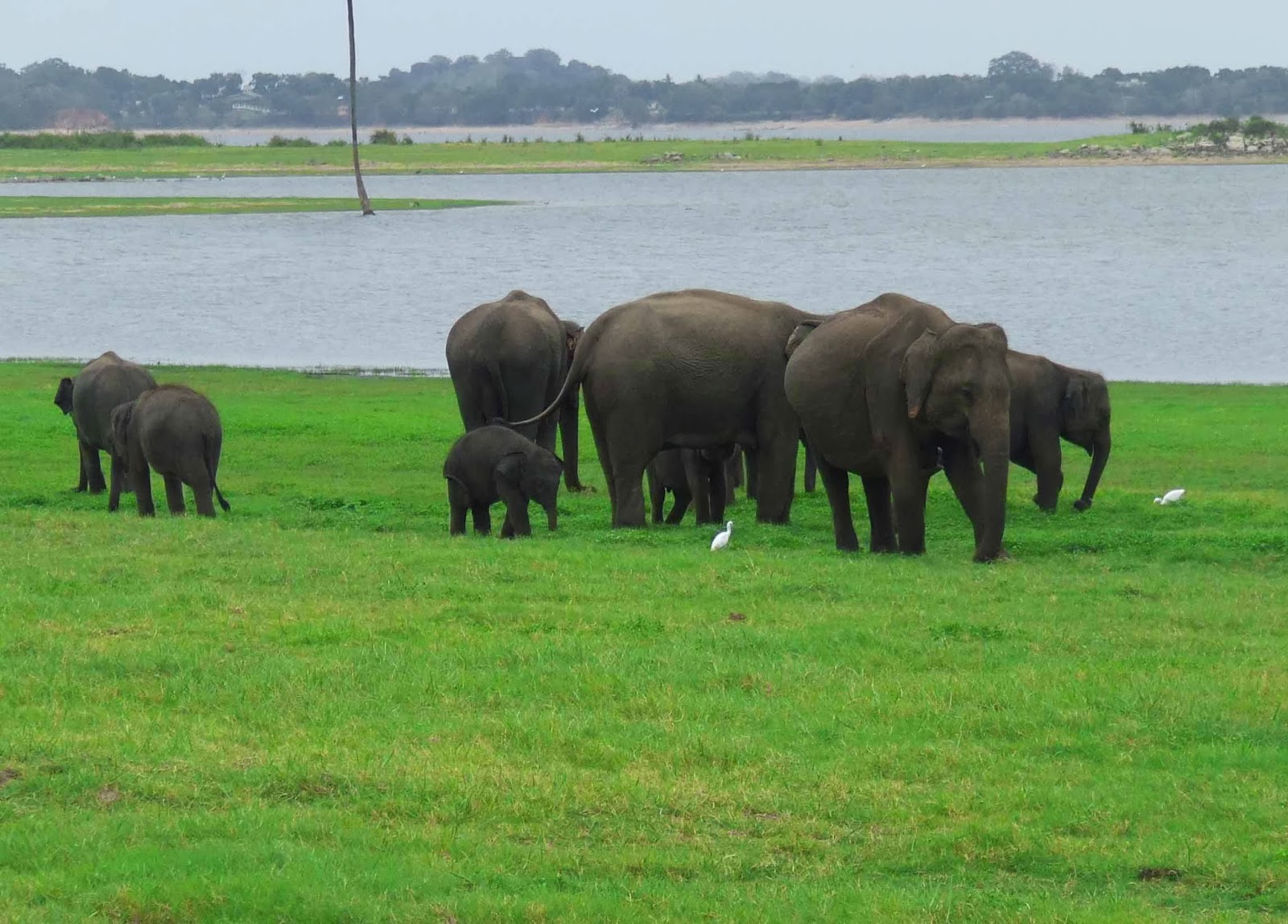
We then moved on to another area in the Park and came across a very numerous herd grazing near a lake.
Elephants, Giritale
This large group, perhaps more than one herd, had many babies.


Elephants, Sri Lanka
Sue
After two hours during which time we counted around 150 elephants we decided to leave them in peace and made our way back to the road.

Unfortunately for them, we met 59 jeeps hurtling down the road on their way in.
Elephant ride

The next day I met this jumbo plodding down a hard road, laden with humans and chained.