Friday, July 3, 2015

Short Tour in Sri Lanka

Friends often decide to visit Sri Lanka while we are there so, after they have explored our beautiful village, I take them on a tour of Sri Lanka's unique historical sights that have piqued their interest. Sri Lanka, although a small island, has very many sites, sights and activities to offer any holiday maker at any time of the year. However, although the distances between places are not great in kilometres, the traffic and conditions on the roads mean that vehicles can travel only at 30 to 50 kmph. With limited time available, in this case just five days, sites and activities needed to be chosen in just one area of the country allowing for a round trip back to the airport. This tour would take in my friends' "must sees" of Kandy, Dambulla, Sigiriya, Polonnaruwa and, finally a beach stop before departure from Katunayake Airport, near Negombo.
Location of the movie Bridge on the River Kwai, Kitulgala
Leaving from Olu Ella, our first stop was for morning tea at Kitulgala, a small village well known for white water rafting and for being one of the locations where the epic movie, the Bridge on the River Kwai was filmed. This 1957 movie was based on a novel about the POWs held by the Japanese in Burma during the Second World War when they were forced to build a railway from Thailand to Burma. In the story by Frenchman Pierre Boulle, a rail bridge is built by POWs and then blown up as a train approaches. Today only a pedestrian swing bridge  now spans the river at Kitulgala. I believe the government has plans to have replica of the rail bridge constructed for tourism purposes and no doubt, to charge tourists hugely to visit it. I remember the film very well. Kitulgala was also the first stop on my honeymoon almost fifty years ago so it is a place of happy memories for me.

Kelani River, Kitulgala
The Aviswella - Hatton road is rather windy and climbs steadily so we stopped for a short break. It was with amusement that I realised I have had to take a break in the same place for different friends when travelling this route! Growing up in New Zealand, windy, climbing roads have never bothered me!


Paddy fields
Kandy is almost always on a visitor's itinerary, mostly because of the Temple of the Tooth and also because it is a central city for travelling north to Dambulla and beyond as well as east  to the hill country and beyond to the South west coast. 
 
Fire walker preparing to walk the hot coals, Kandy

After attending a less than professional national dance show we walked the few metres to the Temple of the Tooth in time for the nightly pooja.

Visiting the Temple of the Tooth at 6pm is a very different experience to a visit during the day. At night the brightly lit Temple is very busy with devotees making offerings to the sacred relic, one of Buddha's teeth believed to have been picked up from the ashes of his funeral pyre. In ancient times in Lanka, it was believed that whoever had the tooth in his possession was the rightful ruler of the country.

On arrival we found the lower level already packed with people standing in front of the casket shrine watching the drummers as they drummed up expectations of this important ritual. We decided to go up the stairs and join the already lengthy line of devotees waiting to make their offerings and see the casket containing the tooth when it was raised to the next level. Flowers in hand, we joined the line and waited with other devotees, some of whom were seated around the walls praying. The drumming reached a crescendo then stopped as the casket was raised. A low hum from the worshippers indicated that the time was now and our line began to move forward, hurried along by an official. Then we were standing in front of an open window, filled with flowers and plates of money. I stopped to try to focus on seeing the casket but had the flowers taken from my hands while my arm was being pulled by an official to move on.   Worship with speed!

I have posted previously about visiting the Temple during the day and, as I like to see the historical pictures and the museum, that's my preference.
This time we were staying at Thilanka Hotel, a very pleasant hotel on the hill near the lookout over Kandy Lake. The rooms were well equipped, clean and the beds comfortable and, while the dishes offered were rather minimal for such a hotel, the food was good. After an early breakfast we left for Dambulla.
Ceiling fresco at Dambulla Cave Temples


Sigiriya in the distance from Dambulla
The Cave temples at Dambulla are half way up a mountain so there are a lot of steps to be climbed, some of them are on a slope and cut out of the huge rocks that are a feature of this part of the country.
Wewa
As it was the end of the peak tourist season and we had not booked ahead, we had problems finding a place to stay for one night in Sigiriya and ended up at Peacock Resort. I would love to own this guesthouse as it has great potential from an excellent location and grounds to almost completed buildings however in no way does it live up to its self description. It was more like a Fawlty Towers experience with food being snatched from in front of me as I was eating it! Apparently it was meant for someone else! In the morning we came out to enquire about our breakfast to find that it had been sitting on our table for an hour. Cold fried eggs and hard toast! We gave it a miss! I've had some rare things happen in guesthouses but having food snatched from me while eating it and cold unordered breakfast sitting on the table for an hour were firsts.


Royal Palace, Polonnaruwa
As a knee injury acquired while climbing up to the Dambulla caves meant that a climb up Sigiriya was not possible, we went directly to Polonnaruwa- one of my favourite historical sites. I've posted previously about this fascinating and beautiful place.
Circular Vatadage, Polonnaruwa
A visit to Polonnaruwa needs at least half a day and, because the monuments and points of interest are spread over a wide area, transport inside the boundaries is needed. Some young people had hired bikes, others were tuk tukking while some hardy older couples were walking between some of the sites in the hot sun. 

By mid day, the sun is rather intense during the dry season so an umbrella is very useful, along with a water bottle. While there are a couple of places where there is an ice cream cart - near the Gal Potha  for one, food and water is really bring your own. As for other essential amenities such as bathrooms - there are none at all except at the Museum where you purchase your entry ticket. At Rs 3250 for foreigners and receiving very many visitors daily some of this money should be used to provide the necessities. Being Sri Lanka, that's unlikely to happen.
Ancient dagaba, Polonnaruwa, Sri Lanka


Wednesday, July 1, 2015

Omeesha Resort, Kalpitiya, Sri Lanka

Omeesha Resort, Kalpitiya,  provided the perfect end to my short Taste of Sri Lanka tour with Olivia and Andrew. What a perfect last night it was with a moonlight cocktails and dinner on the beach! So peaceful and still with the calming sh sh sh sh shshshsh of the waves as they gently found the shore.

Beach at Omeesha Resort, Kalpitiya
Dinner deserves a special mention. It was both beautifully presented and delectable! And served with a genuine cheerful smile ! Unusually for such places in Sri Lanka the menu was big, not only on locally sourced seafood caught on the day, but also Chinese, Indian, Sri Lankan and pasta dishes so it took us some time, and a few cocktails, to make our choices.
Evening on the beach at Kalpitiya
Omeesha Resort is in a less developed part of the beach on the southern part of Kalpitiya. As I walked alone along in the soft surf I felt free to relax and enjoy the moment. No vigilance regarding personal safety for a lone woman was needed here, as it is at Arugum Bay, Hikkadudwa, Bentota and other overdeveloped tourist beaches of the south. Just relax and enjoy. You can here. For now, at least. As we had come down the approach road  on arrival I had noticed blocks of land with signs indicating that this and that company's resort is to be built there soon. Not too soon, I hope. I intend to return for a longer stay on our next trip.
Kalpitiya Beach
The next morning I was up early for another walk along a deserted beach. As I wandered along I dodged the big crabs as they scuttled from the sandbanks, pausing briefly to pick up an incoming tide surge then disappearing safely in the edge of foam. Hovering seabirds then moved on to other targets. The gentle surge produced a more energetic wave that took me by surprise, splashing over my covered knees. A few fishing boats further up the beach were leaving for a day at sea.

Later some of the German tourists went for a swim in the sea. Water sports such as wind surfing, wake boarding and surfing are becoming popular at this lovely part of the central western coast.
Whale and Dolphin watching from Omeesha Resort, Kalpitiya
On the beach in front of Omeesha whale and dolphin watching tourists were heading out to sea. The twenty minute boat ride to these marine mammal's playground would be especially pleasant on the calm, quiet sea today. Sperm whales are often seen between  December and the middle of April while dolphins play around out there pretty much all the time.
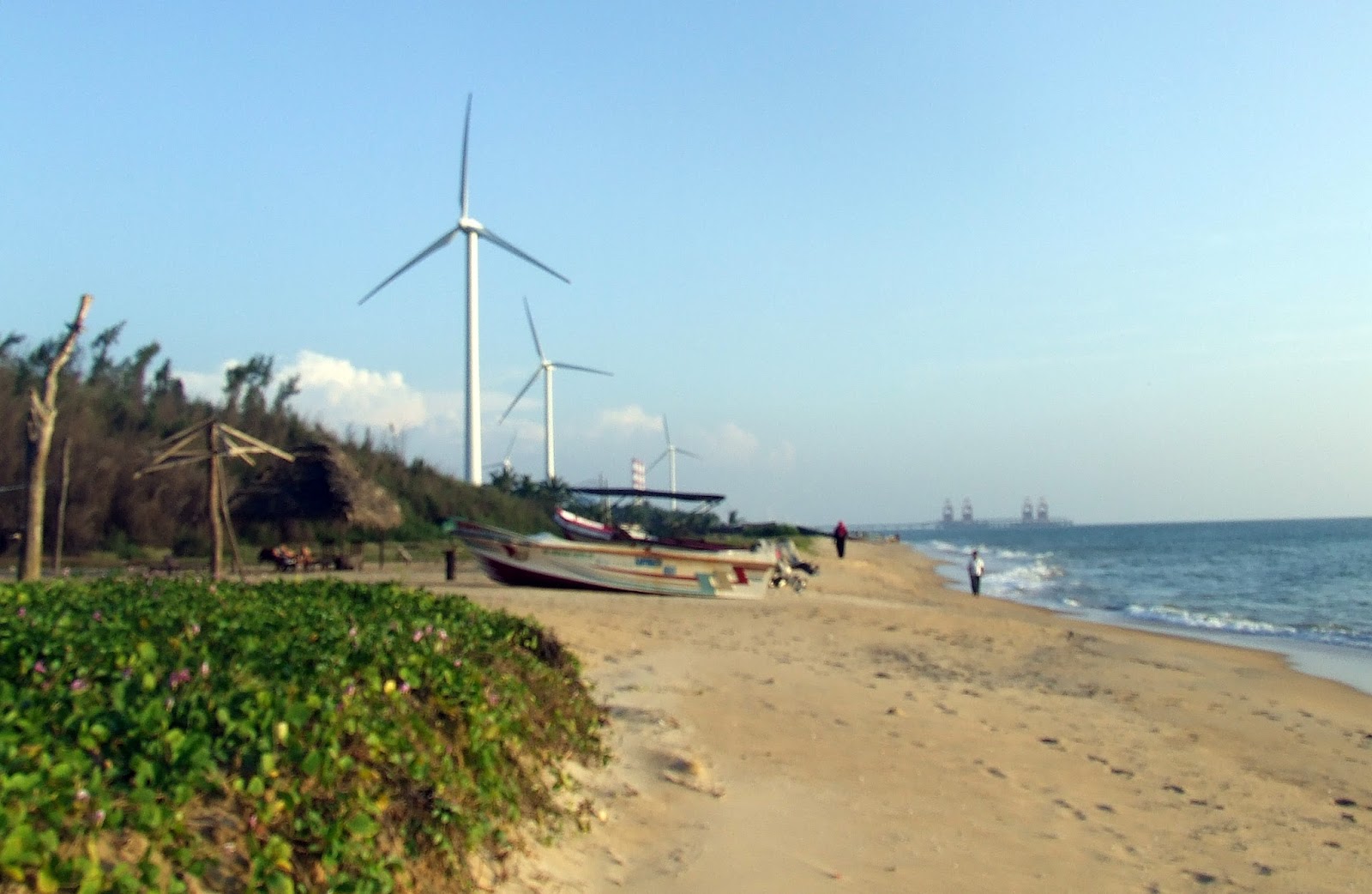
Kalpitiya Beach
The wind farm along the beach line had been a surprise and a bit of a concern for us as we checked in at Omeesha. We had wondered if the noise of the propellers would be troublesome. It wasn't! Once we were inside our cabanas, no sound could be heard at all! When taking a shower under the stars outside, the gentle woosh, woosh was soothing.
Cabana, Omeesha Resort, Kalpitiya


 Omeesha Resort is a family owned and managed resort built by Keerthi [ Nixon] and Mali Peiris in 2011. The two budget, three double and two family cabanas, all built in an eco friendly way are off a central cadjanz fenced and covered walkway with the attractive and comfortable restaurant in the middle. Mali and Keerthi were the nicest of hosts so focused on ensuring their guests have a wonderful holiday, attended to by happy well trained staff, that they have decided to limit the number of cabanas to ten.
Outside shower, Omeesha Resort
 The outside bathrooms were tastefully decorated and equipped with every item a guest might need, as were the cabanas.
Walkway at Omeesha Resort, Kalpitiya
With a last look out over the Indian Ocean towards Kerala, where I would be in a couple of weeks, I made my way to the restaurant for breakfast.
Restaurant, Omeesha Resort
Once again the menu had been a challenge with its variety of offerings. I had decided on coconut roti with dahl and potato curries but first came the fruit plate.
The chef at Omeesha was amazingly young, only nineteen years old, but personally responsible for all the beautifully presented and delicious dishes. He has a great future!
Coconut roti, dahl and potato curry for breakfast
 Breakfast over, we said our goodbyes to our lovely hosts and headed for Negombo, 150 kilometres and about three hours or so south. There I left Olivia and Andrew to wait for their flight from Katunayake airport nearby.

Kalpitiya
Omeesha Resort had been a great find for us, especially after our experience in Sigiriya. Travelling at peak tourism times without pre booking accommodation often results grossly inferior accommodation at high prices somewhere in your itinerary. Sometimes, however, last minute plans need to be made, so the bad has to be endured and the lovely places celebrated.

Kalpitiya has been neglected in the past but its potential is now being recognised. Its location is perfect for a short beach stopover for travellers breaking a long journey between hemispheres. It's also a pleasant and not too long drive from Anuradhapura with Wilpattu National Park within easy reach too.

Our itinerary for this short trip was from Olu Ella to Kitulgala - Kandy - Dambulla - Sigiriya - Polonnaruwa - Kalpitiya - Negombo. I should add that unless you have a lot of time to spare such a short itinerary can only be done with a car and driver. Fortunately I personally know a couple of  sole operator tour guides and one was available for this short and short - notice tour.

Kalpitiya Beach, Sri Lanka

Now that I've found a beautiful, quiet beach with the bonus of excellent accommodation, I will be back soon!


Friday, June 26, 2015

Pearl of the East, Serendib, Taprobane, Sri Lanka. Home.

The chattering of monkeys and sounds of bird call broke through the last moments of my sleep. With eyes half open, I realised that this was the last morning for many months, maybe even a year, that I would awake to the beauty of early morning at Olu Ella. Out I went to the balcony where I watched the slow sun slide through the trees and flash on the white head feathers of fantails as they darted among branches. Other birds called their friends to get moving, to begin their day long food search. 

Olu Ella Inn balcony
There was no need to search for food on my part! I could hear the sounds of people below me as they began preparations for our breakfast. As it was our last breakfast we were sure to be presented with an elaborate one! I decided to go down to meet the day so, after "Good Morning! "to everyone, I went down the steps to the river below. There I sat beside the calm swimming hole watching the yellow bulbuls darting to pick off the insects caught in the new sunlight. I love to sit here, feet in the quiet waters, watching the flowing water find its way through the huge rocks and becoming a fierce rush of white water just a few metres downstream. 

I knew that today this beautiful place would be enjoyed by city dwellers making a weekend escape from the pollution of Colombo by visiting our guesthouse -home to play in the river, enjoying the cool, refreshing water before sampling the traditionally cooked dishes that have earned the guesthouse many recommendations.  
Visitors enjoying the We Oya at Olu Ella Ella Inn
I decided to leave the river today for our visitors to enjoy and made plans to spend the day with a slow trip down the road stopping to take photos at my favourite points. Usually, when we leave home we are moving to a timetable and there's no time to stop for photos. Today I would go alone and stop wherever I pleased! A phone call confirmed that a tuk tuk was available so, after breakfast of freshly made egg hoppers - always my favourite Sri Lankan breakfast - I took my camera and walked down our path to the bridge.
Our Sri Lankan home. Olu Ella Inn
Set among the tea and rubber trees our home is in a hill side village where tea and rubber, together with cardamons and cloves in season, are the income earners for the villagers.
Tea and Ribber trees
Then it was a practiced walk over the high bridge . . .
Bridge over We Oya, at Dombepola

. . . with a pause to take a photo looking downstream . . .
Down stream We Oya from Dombepola bridge

and upstream.
upstream We Oya, Dombepola bridge and after heavy rain.
About five hundred metres along the road is Olu Ella Falls, the fifth highest waterfall in Sri Lanka. I have posted previously about this waterfall.
Olu Ella Falls, wet season
Olu Ella Falls, dry season
My tuk tuk was waiting! The young driver had been told that I wanted to take photos so, after only my first request to stop, he took to stopping wherever he thought a photo should be taken. He really loved his part of the world and stopped exactly where I planned!
Travel by tuk tuk
For the most part, the road is little more than one way only. We are all used to this and there's absolutely no road rage when there are delays with vehicles needing to back up. Instead people use the opportunity to shout news from passing tuk tuks or buses to friends going the other direction!


Seepoth Road, from Yatiyantota
First time visitors to our guesthouse often remark that just getting to our place is an adventure! They enjoy the drive along the windy road, adventures at every corner, through the tea and rubber plantations and the vistas that greet them at every bend.
Getting the day's tea pick ready for collection
Tea is everywhere. As the people usually have only a couple of acres of tea to farm the daily pick is collected by the local tea factories. How much per kilogram they are paid for these green leaves depends on the season but is usually between fifty to sixty rupees a kilogram. The pickers are paid about ten rupees per kilogram for their work so a lot of tea needs to be picked for anyone to earn a living.
Rubber trees, We Oya
Harvesting both tea and rubber is very much dependent on the weather. If there's rain, harvesting is impossible. In recent years there have been very long periods of drought in this area and the people have suffered accordingly. No harvesting equals no income.
Collecting the latex.
When I made my first trip along this road almost fifty years ago I was shocked to see cows little bigger than big dogs. Coming from New Zealand, this horrified me. Now, with breeding assistance from New Zealand, the cows I meet are very much bigger! And can be somewhat intimidating! This one did not agree to having her photo taken.
This area is in a rain corridor so, even on a day that starts out clear and sunny, clouds can appear and dump a bit of water before petering out and returning the sunshine. The hilltops often sit in front of a haze.
We Oya valley
In the wet season the hills are adorned with many high waterfalls. This year I noted that most had dried up, including some I have never known to do so.
Water falls We Oya
What a beautiful setting for the We Oya Rubber Estate's workers' accommodation!
We Oya Rubber Estate
All too soon it was time to turn around.  A phonecall informed me that the visitors had finished their water fun. My turn now!

I was soon back in the water, fish exploring around my feet looking for something to eat. . .
Asian Open Bill, Sri Lanka
. . . and watching the Asian Open Billed stork feeding from the rocks.


Asian Open Bill, We Oya, Sri Lanka
We Oya, Sri Lanka
What a lovely way to end my time in my Sri Lankan home!


Sunday, June 21, 2015

The End of our Northern Road Trip

Last year, 2014, ended up being a big year travel wise for us with our road trip north for two months followed by a six week road trip to revisit places we'd previously seen in passing on the Southern Coast of New South Wales and Victoria and then a another two month trip to Sri Lanka and Kerala, India. 

Now, a year since we left home on our 12,000 kilometre road trip through western Queensland, up into the Northern Territory and a short distance into the East Kimberley part of Western Australia memories keep resurfacing of the wonderful places we saw, people we met and things we learned about the First people of Australia and the geological history of this, the world's smallest continent, the very different pictures of the beauty of the land and more.  As I've now published all the drafts that have languished in the edit box and, because blogs such as mine helped me in planning our own trip, I'll finish with a few thoughts on long distance road travel in a camper van. Assuming that you have researched your route, know where the facilities are along the way and where you might stop over night my Number One Tip is:

You can never recover TIME. DO IT NOW ! Of course in a planned way. If we had made this trip ten years ago as planned, we would have been walking through the National Parks, canoeing through Katherine Gorge, tent camping in wilderness areas off road and so on. Advancing years do mean that life's activities have to be adjusted. If you are already reaching the higher numbers don't worry. Make the adjustments and go anyway. You'll be glad you did!
Carry Spare fuel
Number Two: Be Prepared - for anything. 
Carry at least twenty litres of extra fuel if you are staying on road, more if you are not. We had to use our spare fuel on two occasions. Once because we sailed past a service station without checking that our fuel was at 100% and once because a high wind for five hundred kilometres meant that the engine used more fuel than usual. Don't worry about how much it all costs. You can't go down the road for a discounted price. The highest price per litre diesel we paid was $2.10 at Jabiru and the lowest was $1.53 at both Gin Gin and Charters Towers.

Ensure that you have more than enough supplies of any medications you need to keep you alive to enjoy your trip and a first aid kit stored in a quickly accessible place. 

Add some sticky tape to your tool box. Ours came in handy holding the windscreen together for three thousand kilometres. Know that although temperatures during the day are rather warm, the cooler nights will cause a cracked windscreen to expand and lengthen the crack.

Pack once. Then repack two more times and take out ten percent or more at each pack. If you leave behind something you later need you will be able to remedy that at a town along the way. That does not apply to water. Start with at least five litres plus your personal bottle.
Road house, Dunnmarra
Know where the free stops are. 
[ http://www.caravancaravan.com.au/    is a great resource.] You might want to use them for a break if not for an overnight stop. Know that in season Grey Nomads will be there before lunchtime [ how do they get there so early?] and will be camped in the shady spots, beer in hand as you haul yourself off the tarmac, search for a spot that's not by the toilet, decide to have a quick lunch and try your luck getting to a roadhouse a further six hundred kms up the line before dark. Roadhouses are a good place to stop and have camping grounds too.
Road Train, Northern Territory
Don't fret about meeting road trains or listen to those who try to scare you about them before you leave home, especially if they've never done such a trip themselves. For the most part the roads are looong and flat - ish. You will see them coming towards you and usually you are travelling faster than they are if they are behind you. If you're slow, you will hear them. So, plenty of time to get as left as possible. Secondly, road train drivers are very experienced and courteous road users. They look out for you, or at least, as conversations with them at roadhouses showed, they did for us.
Traffic police, Renner Springs
That brings me to road safety. Do know that, even if there are only a couple of buildings and the settlement can be missed if you blink, you do need to go down to the signed speed limit. Police may be checking and you will be breathalysed. Speed limits in a great part of the Northern Territory do not exist, roads are long, straight and empty. Don't be tempted to travel like a plane as help, should it be needed for either your vehicle or yourself, is a long way off. Possibly at least six hundred kms in places. Stop to stretch your legs every two hours but look for a place such as a truck stop where you can get off the road - it may take an hour or more to find one.
Bitter Springs
My last tip is: see your dentist the day before you leave home. If you do acquire a dental problem that bottle of good brandy you repacked three times will come in handy, along with the Ibuprofen in your first aid kit. With a big enough dose you will be at least comfortable, but not perhaps so happy, until you find that nice dentist at Humpty Doo who will remove the offending tooth.

So, having attended to all of the above, checked that your home is secure, Skype is loaded on your ipad, stopped your mail, all you need to do now is to add a few extra bottles of your favourite wine to enjoy under a clear starry sky in the middle of our wide open country, climb into your holiday home and head for the highway. An unforgettable time is ahead! 

Happy travels!